Food: Onigiri (Japan)

Wednesday, February 10, 2010

Photo: Googlesnatched Onigiri

Onigiri, (Kanji 御握り, Hiragana おにぎり), also known as Omusubi, are Japanese rice balls. They are relatively simple to make, especially once you get used to the basic techniques, but you can also buy surprisingly yummy Onigiri in any konbini (convenience store) in Japan.

Onigiri come in many different varieties. The most common shapes are the little triangles, shown in the picture, and disk-shaped Onigiri. Normally, Onigiri are made of plain, white, sticky rice, and have a single filling in the very center. The most popular fillings are Umeboshi (sour pickled plum) and salmon, although any reasonably dry and strong-flavoured ingredient works well... for example, I have made super-American breakfast Onigiri with sausage and egg. There are also Onigiri that have a topping of fish or ginger instead of a filling, and some Onigiri are formed from rice flavoured with sesame, katsuoboshi (fish flakes), or other traditional seasonings.

A little bit of dried seaweed is wrapped around the rice ball just prior to consumption. The idea of eating seaweed may be a little bit frightening to the uninitiated, but don't be afraid! The flavour of the seaweed is very mild - not even my pickiest friends object to it. The main purpose of wrapping Onigiri in seaweed is to allow you to hold it without getting your fingers too sticky. And, it has a delicious crunch!

Onigiri make great breakfasts and packed lunches. Laura and I started each day in Japan with a nice, filling rice ball or two! Onigiri are easy to eat on the go, although remember that in Japan it is considered rude to eat while walking.

Naantalin Aurinkoinen (Turku, Finland)

Sunday, January 31, 2010

Naantalin Aurinkoinen is a small chain of cafes in Southwestern Finland, mainly Turku and it's suburb of Kaarina. The name means "the Sun of Naantali" -Aurinko means sun, and Naantali is a nearby town known for it's lovely sunshine, even spawning the local idiom "to smile like the sun of Naantali".

The cafe and bakery has a wide variety of goods, from fresh bread and the Finnish favourite 'new potatoes' to pizza, pasta, salad, hotwings, and panini sandwiches. The pastries looked the most tempting to me, though, and I picked the Mansikkajuhlawiener (strawberry pastry) because if you go to Finland in the summer you should eat strawberries at every opportunity.


Photo: Liisa's shot of my Mansikkajuhlawiener.
It was five times more delicious than it looks.


Photo: The storefront of the Kaarina branch I visited.
Looks sweet, doesn't it?


Their website is only in Finnish, but your mouth will water just looking at it: http://www.aurinkoinen.fi/fi/

No Google Map this time, because there are multiple locations. This page on the website shows all the addresses: http://www.aurinkoinen.fi/fi/index.php?option=com_content&task=view&id=62&Itemid=30

A View of Tokyo

Friday, January 29, 2010

We filled our arms with beer and juice and took the elevator to the top of Mayumi's building. Our tour book recommended several places for a good view of Tokyo - from where I was standing, this one was hard to beat.

We were shocked to be able to see Tokyo Tower (think: Japan's Eiffel Tower) from the little rooftop garden. Laura's sharp eyes also picked out two Ferris Wheels, and Rainbow Bridge, which Mayumi hadn't realized she could see before.

We tasted Japanese beer, saw the electric energy of Tokyo shining in the night, listened to the bugs hum and buzz in the bushes around us. And I wondered; those poor, lost bugs - how did they get here? How did we?

- Journal, 07/17/09

Photo: Tokyo by night, as seen from a rooftop in Toranomon.

Chokladkoppen (Stockholm, Sweden)

Thursday, January 28, 2010

No matter the season, Stockholm's Chokladkoppen is delightful. Perfectly situated in the Stortorget square, the center of Gamla Stan, it neighbors the Nobel Museum and the Swedish Academy, and only the imposing Stock Exchange Building seperates it from the Cathedral and the Royal Palace.

Everything in Stockholm is expensive, so once you surrender yourself to that idea, Chokladkoppen, where you can put down about 14$ on a slice of cake or pie and a drink and call it a meal, is a bargain.

Photo: The guilty pleasure Liisa and I counted as a meal.

I've heard the cafe is a lovely, cozy place in the winter, where you can duck in out of the cold for bowls of cocoa and hot pie. Liisa and I visited in the summer, so we sat outside in the square with iced chocolate and white chocolate cheesecake and watched the world go by instead. Everything tasted creamy and fresh, and the orange slices added a bright, tangy note to both the flavour and the presentation.

The food is delicious, the atmosphere and the location are top notch, and you won't even have to go broke to experience it. I'll definitely be returning to Chokladkoppen during my next trip to Stockholm.

Photo: Chokladkoppen is the orange building in this
picture from Wikipedia's Stortorget article.


View Larger Map

Photo: Toxic Environment Cow (Costa Rica 2008)

Monday, January 25, 2010


Toxic Environment Cow

Where: San Jose, Costa Rica
When: Afternoon, June 5th 2008

During my visit to Costa Rica in June 2008, San Jose was holding a CowParade public art exhibit. Dozens of artists had decorated cows, placed throughout the city, in ways that were sometimes beautiful, sometimes hilarious, and sometimes expressed a poignant social or political message. We made it our mission to look for these cows wherever we went. This cow, with it's gas mask, green hooves, and carbon emissions statistics printed in green, warned passers-by against creating a toxic environment.

Photo: Buddhapada in Kamakura (Japan 2009)

Wednesday, January 20, 2010


Buddhapada in Kamakura

Where: Kamakura, Japan
When: Afternoon, July 16th 2009

I found this decorated stone in Kamakura's Hase-Kannon Temple. It is a stylized depiction of the footprints of Buddha. In early Buddhist art, it was considered taboo to directly depict a being as sacred as the Buddha, so they alluded to his presence by showing his footprints, called Buddhapada in Sanskrit.

These Buddhapada are covered with a variety of symbols. Look at the most prominent one, which looks like a sun or wheel. If it looks familiar to you, you may be thinking of the Flag of India, which has a similar design in the center. The wheel shown on both these footprints and the Indian flag is a dharmacakra, or a "wheel of law", and symbolizes the Buddha's path to enlightenment.

Japan's many sacred places are filled with items and objects that are often laden with symbolism. Knowing even a little bit about the many cultural traditions that make up Japan can add a lot to a trip through the country.

Late Night Okonomiyaki (Miyajima, Japan)

Wednesday, January 13, 2010

Miyajima shuts down quickly after the bulk of the tourists leave around 4 pm. The majority of those who spend the night on the island eat dinner in their ryokans or hotels, so when 6 o'clock rolled around, Laura and I found that nearly all the town's restaurants had already shuttered for the night. Luckily, the owner of our ryokan told us that a small Okonomiyaki restaurant a few doors down was open until 8.


I ordered yakiudon with shrimp and Laura ordered yakisoba with pork. As usual with okonomiyaki they put just about a whole head of cabbage in each of ours. It boiled down a lot, but there was still more food on our plates than we could possibly eat. It was good, too - the amount and flavour of the sauce was just right. This wasn't the best food we ate in Japan, but it was definitely a solid choice for a 'late night' meal.

Since the tiny okonomiyaki restaurant we ate at isn't shown on the map, the best thing to do would probably be to follow these directions to the Ryokan Kawaguchi, and follow the road it's located on a few storefronts north. If you're going there at night, it should be one of the only places open, so pretty much impossible to miss.


View Larger Map

Cereal with Milk (and Tea) in Costa Rica

Thursday, January 7, 2010


The first time you see cereal prepackaged with milk in Costa Rica, you might think you're going a bit crazy.

But, once you remember that most of the milk sold in Latin America is super-pasteurized and doesn't need refrigeration until it's opened, you get used to it fairly quickly.

That is, at least, until you find something like this:

Yep. That's Iced Tea with Lemon. Always delicious over your honey oats.

La Heredia

Monday, December 14, 2009

Heredia was much like San Jose. Exteriors were dirty concrete and rusted metal, with the junctures between the two often neglected. To say there was no insulation would be an understatement – a Missouri rainstorm would whip in through every crack.

We were assigned a scavenger hunt in the Mercado. They divided us into groups to look for items from a list, which we were forbidden to show anyone - we were meant to ask people where we could buy things and how they were used. All of our things (with one exception) turned out to be herbs and spices, so we found ourselves bothering the same people again and again.

A group of exhausted high schoolers need some sort of authority figure to maintain organization, so when it came time to eat lunch, in particular, there were arguments. For about half an hour we bickered over where to eat, as half the group wanted cheap, authentic food – the kind most prevalent in the Mercado itself, while the other half couldn’t be persuaded to go anywhere near the street vendors.

The group finally split and I stayed with the Mercado group. The little bar we ate at probably left us more exposed to thieves and pickpockets than any other place we went to on the trip, but I wasn’t at all worried about the food. They prepared it right in front of us, and meat and cheese and cilantro smells wafted over the dirty glass that separated the kitchen from the counter. My first full and real Costa Rican meal - Pollo con Gallo Pinto - was so delicious that I even ordered a cheese tortilla to finish it off.

- Journal, 06/06/08


Photo: The Mercado of Heredia.

Photo: A Sushi Feast (Japan 2009)

Thursday, December 10, 2009


A Sushi Feast

Where: Tokyo, Japan
When: Evening, July 16th 2009

After a day trip, I returned to Tokyo to find an unbelievably delicious feast waiting at Mayumi's house. The sushi was much better than any I'd ever eaten before. There was sweet eel and egg sushi, chewy squid, flavorful salmon roe, and chewy, translucent squid alongside more familiar varieties. Every bite was amazing.

Food: Japanese Shave Ice

Wednesday, December 2, 2009

Snow Cones can be refreshing on a hot day, but I'm usually disappointed by hard, course ice that lets all the syrup slide straight to the bottom of the paper cone. In Japan, I found Kakigōri (かき氷), or shave ice - a fabulous dessert which made me reconsider the potential of the snow cone.

Photo: Melon shave ice with ice cream topping. (Kanazawa, Japan)

Served not only at carnivals and roadside stands but also in nice restaurants alongside ice cream and cakes, most of the shaved ice in Japan is similar in texture to American snow cones, if a bit softer and more like, well, fresh snow. But at least once, in Nikko, I found shave ice that seemed to literally have been shaved from a block - it was as smooth as ice cream, and had a delightful crispness.

The syrup that tops Kakigōri is not unlike that used on American snow cones, with familiar flavours like strawberry, lemon, and grape alongside melon, sweet plum and green tea. It is also common to pour condensed milk onto the ice, adding additional sweetness and richness. Many Japanese also like to add mild sweet bean paste, mochi rice cakes, or even ice cream to their shave ice.


Photo: Laura and I found this incredible Kakigōri in Nikko. The texture was totally different than that of an American snowcone, or even the other Kakigōri we had tasted. Served with strawberries in thick syrup and condensed milk, this was the most delicious dessert I have ever eaten in Japan.

Photo: Wooden Reindeer (Scandinavia 2008)

Sunday, November 22, 2009


Wooden Reindeer

Where: Skansen, Stockholm, Sweden
When: Afternoon, June 27th 2008

I loved this little wooden reindeer in Skansen, an outdoor museum in the middle of Stockholm. I noticed the way the face is suggested with broad, simple cuts from the wood, as well as the cute pose and the real antlers.

Photos: Finnish Seagulls (Scandinavia 2008)

Thursday, November 5, 2009


Finnish Seagulls I

Where: The Archipelago Sea, Finland
When: Evening, July 8th 2008

This photo is something of a joke. Since I grew up so far from the sea, I have a certain liking for seagulls. I took dozens of pictures of them in Finland, to Liisa's amusement and disbelief. Yes, I know they're flying rats and all of that, but I love the grey and the white and the way they cry. For me, the sound is shorthand for, "You're far from home."


Finnish Seagulls II

Where: The Archipelago Sea, Finland
When: Evening, July 8th 2008

This is one vicious little seagull. I don't even know how his wings are moving like that.

Kamakura's Tsurugaoka Hachimangu

Wednesday, November 4, 2009

Basic Statistics:
What? Shinto Shrine
Where? Kamakura, Japan
Why? It's the most important shrine in Kamakura, which used to be the capital of Japan. It's painted with bright colours and filled with fields of waterlilies. Kamakura, including Tsurugaoka Hachimangu, makes a very convenient day trip from Tokyo.
How Much? Free

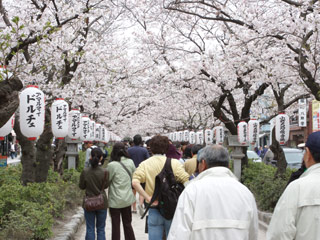
The entrance to Tsurugaoka Hachimangu is a short walk from the Kamakura train station. Most guidebooks recommend approaching the shrine via Wakamiya Oji, a very long and old ceremonial road that's lined with lovely cherry trees. In the spring it is blooming and beautiful like in this googlesnatched photo:


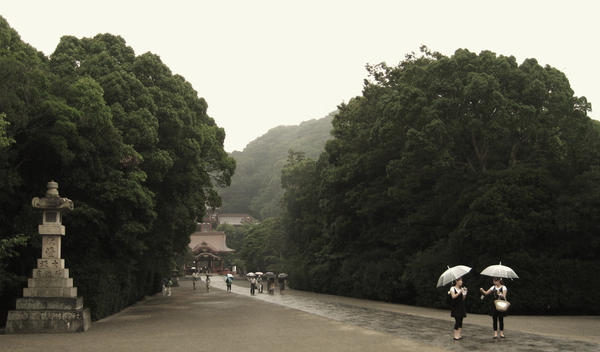
When I was there, it looked like this, which I also liked:


This Tori means you're in the right place:


Don't forget to wash out your hands and mouth with the water here:


Follow these stairs to reach the main shrine, but notice the large Ginkgo tree on the left.


I found myself drawn to this tree for some reason, even though I couldn't read any of the sign posted in front of it. I later found out that it is more than 1000 years old, and that Kugyo Minamoto hid behind it before stabbing and killing his uncle Sanetomo Minamoto, the Third Shogun, in 1219.


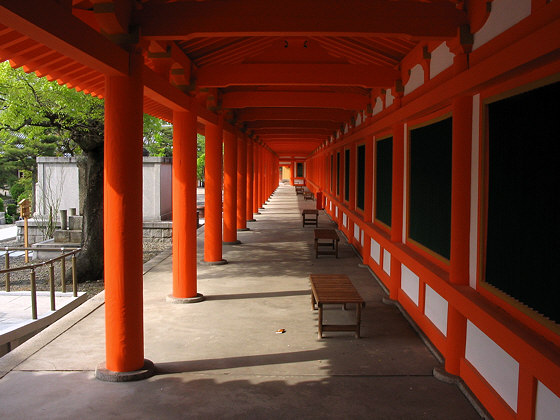
Most of the shrine buildings are painted a brilliant vermilion.


Don't miss the fields of waterlilies. I had the good luck to be rushed through them by a crowd of adorable children as the shrine's school was letting out.


Photo: Sunlight Through Tori (Japan 2009)

Tuesday, October 20, 2009


Sunlight Through Tori
Where: Fushimi Inari-Taisha, Kyoto, Japan
When: Afternoon, July 24th, 2009

We visited Fushimi Inari Shrine's long tunnels of famous tori as the afternoon sun hung low in the sky and shone across the covered paths. I love this picture because the black and sunlit vermilion remind me of the wings of monarch butterflies.

Photo: Rainy Day in Kamakura (Japan 2009)

Monday, October 19, 2009


Rainy Day in Kamakura
Where: Tsurugaoka Hachimangu Shrine, Kamakura, Japan
When: Morning, July 16th, 2009

It was raining - it was perfect.

Food: Koya Tofu (Japan)

Does freeze-dried Tofu sound appealing? How about intriguing, at least? If you're anywhere near Mt. Koya, you'll probably have the chance to taste this regional specialty. I personally tried it as part of the vegetarian dinner I ate while staying at Sanboin temple. It's interesting, to say the least.

While many foods can be described as spongy, Koya Tofu could easily be mistaken for an actual sponge. It absorbed an immense amount of liquid, has little flavour by itself, and the texture is exactly what you'd expect from a synthetic bath sponge. I was somewhat surprised it didn't taste soapy.


Picture: Some Googlesnatched Koya Dofu.

Kyoto's Sanjusangendo

Friday, October 16, 2009

Even one of Sanjusangendo's statues of Kannon, the Buddhist goddess of mercy, is impressive. Each one stands life sized and is covered in gold leaf, has eleven faces, and twenty one sets of arms to symbolize the goddess's thousand. Can you picture one Kannon now? Good.

Now imagine 1001 of them, each one unique and hand carved from Japanese cypress, crowded into Japan's longest wooden building. A giant statue of the Thousand-armed Kannon sits in the middle of the hall, with 500 smaller (merely life sized) Kannons on each side. The youngest of the statues are almost 700 years old. The effect is mind blowing.


As if the Kannons weren't enough, the hall also contains the statues of 28 Guardian deities and of Fujin and Raijin, the terrifying Japanese Gods of Wind and Thunder.


The temple's exterior, painted a striking vermilion, is worth a look as well.


Don't hurry off once you've seen the statues, or you'll miss the fascinating story of the other side of the hall, which has been used for the Tōshiya archery tournament since the 1600's. A small but fascinating display lists the truly awe inspiring records of Japan's best archers.

In the Oyakazu competition, for example, archers shoot as many arrows as they can within a 24 hour period, hoping to 'clear' - shoot the length of the hall without hitting the roof, floor, or pillars - as many arrows as possible.

In 1686, Wasa Daihachiro shot 13,053 arrows in Oyakazu, clearing 8,133 of them. This averages out to nearly 6 arrows a minute for twenty four hours straight.

Sanjusangendo is in Kyoto, Japan.

Food: Tofu

Friday, October 9, 2009


Sadly, in America many people are afraid of Tofu. This may have to do with a strong association of Tofu with a vegetarian diet - the idea of a "Tofurkey" served for Thanksgiving sounds to many Americans like an unholy violation of their traditions. Still, I say sadly because Tofu can really be delicious.No one should try tofu only once and decide it's not for them, because it simply comes in so many different forms, with vastly different textures and methods of preparation. I will update this list of featured Tofu types and dishes as I write more about this versatile foodstuff.

Types of Tofu (or closely related products):

Yuba: "Tofu Skin" (Chewy)

Koya Tofu: Freeze Dried Tofu (Spongy)

Food: Yuba (Japan)

Yuba, also known as soybean skim, is a Japanese food made from the skin that forms on the surface of boiling soy milk. The result is a bundle of thin, rubbery layers of a firm, tofu like substance. Yuba can be shaped in order to texturally resembled other foods, such as chicken breasts, and is often fried to give it a firmer skin. You can even deep fry yuba, like in this googlesnatched photo!


The first time I ordered a dish with yuba, I didn't know what it was. This is common in Japan and probably for the best. I would have missed out on many culinary adventures had I been afraid to eat some Japanese dishes based only on their not always appetizing English names! My first yuba experience was a clam chowder, and I almost mistook the yuba for incredibly tender clams. After this I took every opportunity to order yuba.

As with other Japanese Tofu dishes, my advice for yuba is to give it a try. Don't think about past experiences with soyburgers or tofurkey back home. Japan has many soy products in it's cuisine, and they vary widely by texture, taste, and application. You are not guaranteed to enjoy yuba, but it deserves to be given a chance.

Blog Widget by LinkWithin