

Wooden Reindeer
Where: Skansen, Stockholm, Sweden
When: Afternoon, June 27th 2008
I loved this little wooden reindeer in Skansen, an outdoor museum in the middle of Stockholm. I noticed the way the face is suggested with broad, simple cuts from the wood, as well as the cute pose and the real antlers.
Photo: Wooden Reindeer (Scandinavia 2008)
Sunday, November 22, 2009
Photos: Finnish Seagulls (Scandinavia 2008)
Thursday, November 5, 2009

Finnish Seagulls I
Where: The Archipelago Sea, Finland
When: Evening, July 8th 2008
This photo is something of a joke. Since I grew up so far from the sea, I have a certain liking for seagulls. I took dozens of pictures of them in Finland, to Liisa's amusement and disbelief. Yes, I know they're flying rats and all of that, but I love the grey and the white and the way they cry. For me, the sound is shorthand for, "You're far from home."
Finnish Seagulls II
Where: The Archipelago Sea, Finland
When: Evening, July 8th 2008
This is one vicious little seagull. I don't even know how his wings are moving like that.
Kamakura's Tsurugaoka Hachimangu
Wednesday, November 4, 2009
Basic Statistics:
What? Shinto Shrine
Where? Kamakura, Japan
Why? It's the most important shrine in Kamakura, which used to be the capital of Japan. It's painted with bright colours and filled with fields of waterlilies. Kamakura, including Tsurugaoka Hachimangu, makes a very convenient day trip from Tokyo.
How Much? Free
The entrance to Tsurugaoka Hachimangu is a short walk from the Kamakura train station. Most guidebooks recommend approaching the shrine via Wakamiya Oji, a very long and old ceremonial road that's lined with lovely cherry trees. In the spring it is blooming and beautiful like in this googlesnatched photo:
When I was there, it looked like this, which I also liked:
This Tori means you're in the right place:
Don't forget to wash out your hands and mouth with the water here:

Follow these stairs to reach the main shrine, but notice the large Ginkgo tree on the left.
I found myself drawn to this tree for some reason, even though I couldn't read any of the sign posted in front of it. I later found out that it is more than 1000 years old, and that Kugyo Minamoto hid behind it before stabbing and killing his uncle Sanetomo Minamoto, the Third Shogun, in 1219.
Most of the shrine buildings are painted a brilliant vermilion.
Don't miss the fields of waterlilies. I had the good luck to be rushed through them by a crowd of adorable children as the shrine's school was letting out.
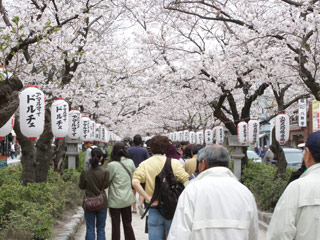

Photo: Sunlight Through Tori (Japan 2009)
Tuesday, October 20, 2009

Sunlight Through Tori
Where: Fushimi Inari-Taisha, Kyoto, Japan
When: Afternoon, July 24th, 2009
We visited Fushimi Inari Shrine's long tunnels of famous tori as the afternoon sun hung low in the sky and shone across the covered paths. I love this picture because the black and sunlit vermilion remind me of the wings of monarch butterflies.
Photo: Rainy Day in Kamakura (Japan 2009)
Monday, October 19, 2009
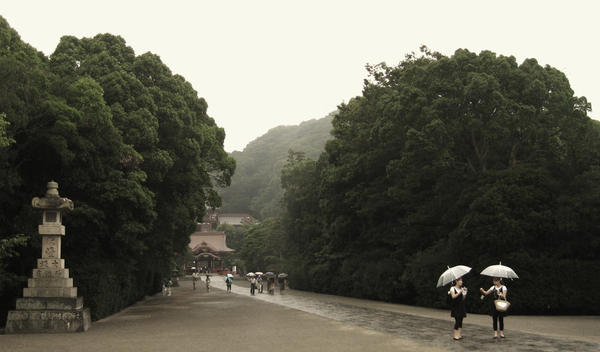
Rainy Day in Kamakura
Where: Tsurugaoka Hachimangu Shrine, Kamakura, Japan
When: Morning, July 16th, 2009
It was raining - it was perfect.
Food: Koya Tofu (Japan)
Does freeze-dried Tofu sound appealing? How about intriguing, at least? If you're anywhere near Mt. Koya, you'll probably have the chance to taste this regional specialty. I personally tried it as part of the vegetarian dinner I ate while staying at Sanboin temple. It's interesting, to say the least.
While many foods can be described as spongy, Koya Tofu could easily be mistaken for an actual sponge. It absorbed an immense amount of liquid, has little flavour by itself, and the texture is exactly what you'd expect from a synthetic bath sponge. I was somewhat surprised it didn't taste soapy.
Picture: Some Googlesnatched Koya Dofu.

Kyoto's Sanjusangendo
Friday, October 16, 2009
Even one of Sanjusangendo's statues of Kannon, the Buddhist goddess of mercy, is impressive. Each one stands life sized and is covered in gold leaf, has eleven faces, and twenty one sets of arms to symbolize the goddess's thousand. Can you picture one Kannon now? Good.
Now imagine 1001 of them, each one unique and hand carved from Japanese cypress, crowded into Japan's longest wooden building. A giant statue of the Thousand-armed Kannon sits in the middle of the hall, with 500 smaller (merely life sized) Kannons on each side. The youngest of the statues are almost 700 years old. The effect is mind blowing.
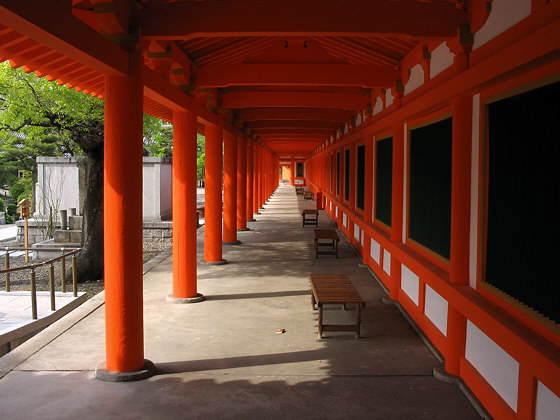
The temple's exterior, painted a striking vermilion, is worth a look as well.
Don't hurry off once you've seen the statues, or you'll miss the fascinating story of the other side of the hall, which has been used for the Tōshiya archery tournament since the 1600's. A small but fascinating display lists the truly awe inspiring records of Japan's best archers.
In the Oyakazu competition, for example, archers shoot as many arrows as they can within a 24 hour period, hoping to 'clear' - shoot the length of the hall without hitting the roof, floor, or pillars - as many arrows as possible.
In 1686, Wasa Daihachiro shot 13,053 arrows in Oyakazu, clearing 8,133 of them. This averages out to nearly 6 arrows a minute for twenty four hours straight.
Sanjusangendo is in Kyoto, Japan.

Subscribe to:
Posts (Atom)

